Ever stared at a specialty coffee menu with no idea where to start? With dozens of origins rotating through every year, choosing can feel overwhelming. In this guide, we break down how we sort our coffee at Pergamino, what sets each category apart, and how to find the right one for your experience level and taste.
How We Sort Our Coffee: Three Families and a Little Secret
We organize all of our coffee by two things: how long it’s available during the year, and how distinctive its origin is. That gives us three main categories, plus a fourth, special group that only shows up once in a while:
-
House coffees: available year-round, in every shop. The perfect way into specialty coffee.
-
Seasonal origins: here for a limited time only, usually 45 days to two months, and sourced from specific partner farmers.
-
Special editions: these last about three weeks and sit at the very top of our lineup, with rare varieties or unusual processing methods.
-
The 1%: a nearly secret category that pops up now and then with extraordinary, very limited lots.
Think of these categories as steps on the same path. That’s why we usually suggest starting with a house coffee before moving on to more complex origins. It’s not that some are “better” than others. It’s about building your palate one step at a time.
House Coffees: Your Way Into Specialty Coffee
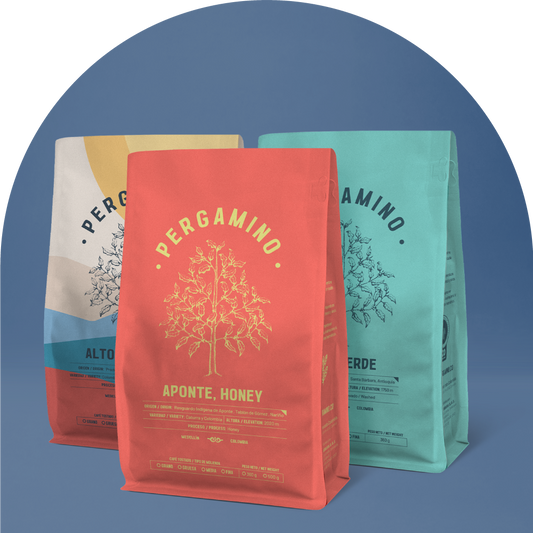
House coffees are our ambassadors. You’ll find them in every shop, every day of the year, and they’re designed so anyone, whether or not you’ve had specialty coffee before, can find a clear, delicious place to start. There are three: Lomaverde, Alto de Letras, and Alonso.
Lomaverde: Our Signature Coffee
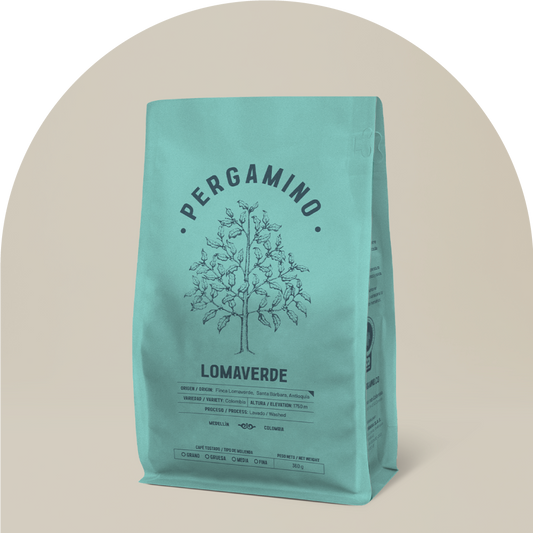
Loma Verde is the heart of Pergamino. We grow it ourselves on our farm of the same name in Santa Bárbara, Antioquia. It’s the classic high-quality Colombian profile: notes of chocolate and caramel, with a pleasant, balanced citrus acidity.
It’s the first coffee we recommend to anyone new to specialty coffee. Easy to describe, easy to enjoy, and great at any time of day. If you’re ever unsure what to suggest to a customer who’s just getting started, Loma Verde almost never misses.
Alto de Letras: A Tribute to Colombian Cycling
Produced by partner farmers in the department of Tolima, Alto de Letras is well balanced, with notes of red fruit, dark chocolate, and ripe strawberry, and a finish that reminds you of honey.
The name is no accident. Alto de Letras is an 80-kilometer (about 50-mile) climb between the departments of Caldas and Tolima, a real test for pro and amateur cyclists alike. Cycling is as much a part of Colombian culture as coffee, so we wanted to honor this iconic route. That’s why the bag is dressed in the colors of the Colombian flag.
Fun fact: Alto de Letras started out as a seasonal origin, meant to be released just once. But people loved it so much that it became a permanent house coffee. The reason? A fruitier profile and that “something extra” that appeals to anyone who enjoys a little more nuance in the cup. It’s also very versatile. It works just as well as a filter brew as it does as espresso, even with milk. And it’s roasted a bit lighter than Loma Verde, precisely to keep that ripe-fruit character that makes it so distinctive.
Alonso: For Those Who Want Something Bolder
Alonso is the only house coffee with a darker roast, which gives it a bolder flavor and a pronounced dark chocolate note. It comes from partner farmers in different regions of the country.
It used to be called “Alonso Espresso,” but we renamed it “Fuertecito” (“little strong one”). It’s a great fit if you have an espresso machine at home, since a darker roast is usually easier to dial in and pulls a less acidic shot. But it also shines as a filter brew. It’s the perfect recommendation when a customer says they like their coffee “stronger” or “more bitter.” That profile tends to win over people who are used to darker roasts, or who love a bolder finish in the cup.
Seasonal Origins: Coffees with a Name and a Story
Once you’re comfortable with specialty coffee, maybe you’re a regular or you’ve tried a few origins, seasonal origins are the natural next step.
Unlike house coffees, these come from very specific partner farmers: a single farm, a family, or even a particular community. And as the name suggests, they’re not around all year. Depending on the region of Colombia, some areas harvest once or twice a year, so these coffees usually show up in our shops just once, for about 45 days to two months. That limited window is what makes them special.
What Sets Them Apart From House Coffees?
Mainly, more aromatic complexity. Loma Verde and Alto de Letras score around 84 points on the cupping scale, while seasonal origins have to score at least 86. That difference might not mean much if you’re not familiar with the scoring system, but you’ll taste it: a richer, more nuanced cup.
Two examples show what this category looks like:
- A lighter-roasted coffee with a yellow-fruit profile and notes of orange, black tea, and plum.
-
Aponte, one of our favorites and a nearly annual fixture, produced by the Inga Indigenous community in El Tablón de Gómez, in southern Colombia. It’s honey processed: the cherries are picked at peak ripeness, pulped, and dried with some of their mucilage still on, which oxidizes on the seed. The result is a coffee with ripe-fruit notes and a stronger sense of sweetness.
Every seasonal origin also comes with its own story: the community behind it, the region it comes from, the variety that makes it unique. Connecting with that story, and not just the flavor, is a big part of what makes this category special.
Special Editions: The Top of Our Lineup
Special editions are, as the name suggests, the most exclusive coffees you’ll find at Pergamino. They stay in shops for a very short time, around 20 days, a month at most, and can come from our own farms or from partner producers.
What sets them apart is that they almost always have a standout feature: an exotic variety (like pink bourbon, chiroso, or geisha), an unconventional processing method at the farm (washed, honey, or natural, done in a particular way), or a one-of-a-kind origin whose volume is too small to qualify as a seasonal origin. Sometimes an exotic variety is paired with an uncommon process, which makes for a truly singular cup.
Like all specialty coffee, these editions meet three basic conditions: full traceability, high quality in the cup, and a fair price for the producer.
The 1%: When Excellence Is Almost a Secret
There’s one last category that isn’t always in our shops, but it’s worth knowing about: the 1%. These are extraordinary lots that happen when our cupping lab finds exceptional coffees in volumes too small, sometimes just 40, 100, or 200 bags, to launch as a seasonal origin (which needs between 8,000 and 13,000 bags) or even as a special edition (between 1,000 and 2,000 bags).
To make it into this category, a coffee has to score above 87 points, an exceptional level of aromatic complexity. The name comes from the fact that only about 1% of all Colombian coffee is estimated to reach specialty grade, and of that 1%, only a tiny fraction reaches this higher level. So for us, they’re the 1% of the 1%.
Because these lots are so limited, we sell them mainly through pre-orders on our website, though we sometimes keep a small amount in shops for tastings. They’re sold only as whole beans, never ground, in 200 g bags, made for people with a grinder at home. Their flavors are so delicate that they’re best enjoyed freshly ground.
How to Choose Your Pergamino Coffee
If you had to sum it all up in one idea, it would be this: our categories aren’t a ladder from “best” to “worst.” They’re a map for exploring specialty coffee at your own pace.
-
Just starting out, or want a reliable everyday coffee? A house coffee is your best starting point.
-
Have some experience and want more complex flavors with a story behind them? Try a seasonal origin.
-
Looking for something truly one of a kind, with rare varieties or uncommon processing? Don’t miss our special editions.
-
And if you’re lucky enough to come across the 1%, you’ll know you’re holding something truly exceptional.
One last note on sizes: most of our origins come in 360 g and 500 g bags, special editions come only in 360 g, and the 1% coffees come in 200 g.
The Bottom Line
Sorting our coffee into house coffees, seasonal origins, special editions, and the 1% isn’t just a technicality. It’s how we guide you along the way, so every cup makes sense for where you are in your specialty coffee journey. No coffee is “less” than another. They’re all special, all the result of farmers committed to quality, and any one of them will give you a great cup.
So the next time you visit a Pergamino shop, you’ll know where to start: ask about our house coffees, try the current seasonal origin, or see if a special edition is available. Every category is a chance to keep exploring, one cup at a time, and to taste everything Colombian coffee has to offer.
Frequently asked questions
What’s the difference between a house coffee and a seasonal origin?
House coffees (Loma Verde, Alto de Letras, and Alonso) are available year-round in every shop and are ideal if you’re just getting started with specialty coffee. Seasonal origins come from a specific farmer, family, or community, have more aromatic complexity (a minimum score of 86), and are only available for 45 days to two months, usually once a year.
How long do special editions stay in shops?
Special editions are usually available for around 20 days, a month at most. They’re defined by an exotic variety, an unconventional process, or an origin so unique that its volume is too small to launch as a seasonal origin.
What is Pergamino’s 1% coffee?
It’s our most exclusive category: extraordinary, very small lots (sometimes just 40 to 200 bags) that score above 87 points on the cupping scale. They represent the 1% of the 1% of Colombian specialty coffee, and they’re sold mainly through pre-orders on our website, as whole beans only, in 200 g bags.