Did you know that more than 90% of the coffee consumed in Colombia is actually pasilla-grade? In this article, we walk through the three levels of physical quality in green coffee, which defects set each one apart, and how those defects are counted and classified under the standard we follow at Pergamino.
A Quick Reminder: Our Definition of Specialty Coffee
Before we dive in, let’s revisit the three pillars that define specialty coffee for us: extraordinary physical and sensory quality, full traceability to the producer, and a fair, high price paid for that coffee. In this article, we’re focusing on the first pillar only: physical quality.
Three Worlds of Physical Quality in Colombian Coffee
In Colombia, there are broadly three categories of physical quality for green coffee: pasilla, excelso (also known as UGQ), and specialty coffee. Each has its own standard for how many defects, and what kind, it can contain.
Pasilla: The Quality Most People Drink
Pasilla is all the coffee we separate out during milling because of defects or foreign material. It’s easy to think of it as nothing more than waste, but the reality is that more than 90% of the coffee consumed in Colombia is pasilla-grade. Even the pasilla produced domestically isn’t enough to meet demand, so Colombia imports it from countries like Brazil, Peru, and Ecuador, in even lower and cheaper grades. This kind of coffee ends up mostly in instant coffee and the budget brands sold on the mass market.
One important note: because we’re so demanding about our raw material, some good beans also end up in our pasilla by mistake, thanks to the machines’ margin of error. So unlike traditional pasilla, which in theory shouldn’t contain a single good bean, ours usually includes a share of quality beans, and that’s why it commands a small premium.
Excelso (or UGQ): The Export Standard
Excelso, also called UGQ (Usual Good Quality), is the category that corresponds to the minimum export standards. Until fairly recently, before specialty coffee took off, it was the grade commonly sold in the Colombian market under labels like “gourmet.” It allows a limited number of first- and second-category defects (we explain what that means below): up to 24 defect points in a 500-gram sample.
Specialty Coffee: The Strictest Standard
Specialty coffee, the category we work in at Pergamino, follows the strictest standard of the three. We mainly follow the standards of the Colombian National Federation of Coffee Growers, which are comparable to, and even a bit stricter than, those of the international Specialty Coffee Association (SCA). Under this standard, a specialty coffee must have zero primary defects and no more than 15 secondary defect points, always measured on a 500-gram sample.
Primary Defects: The Most Serious Ones
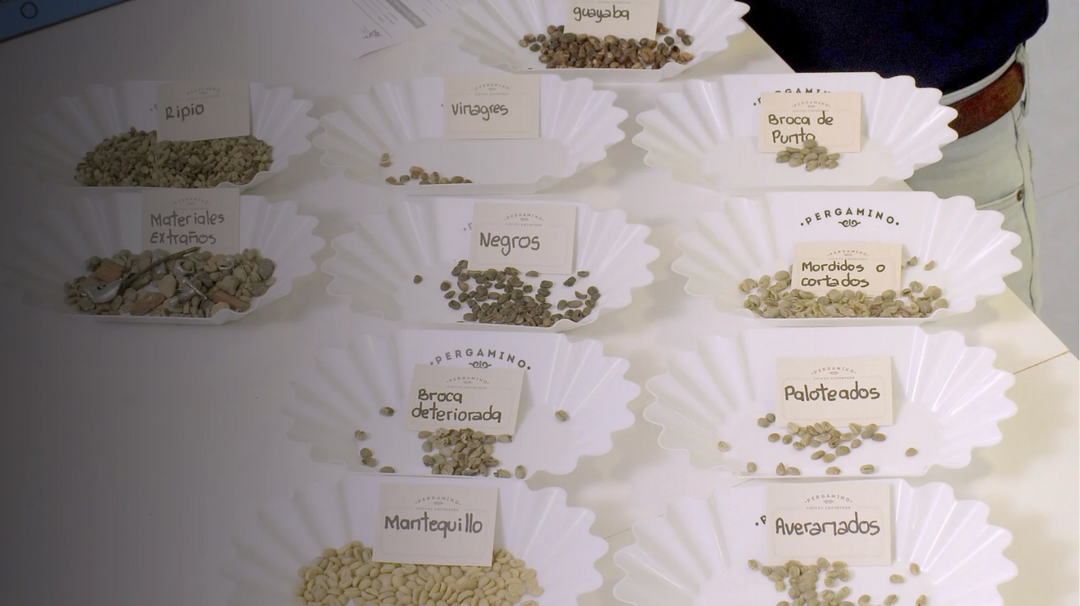
Defects fall into two categories based on severity. Primary defects are the most serious because they tend to directly affect the cup. Secondary defects are less serious and, in many cases, you can’t even taste them. These are the main primary defects:
-
Foreign material: because coffee is grown and processed outdoors, foreign objects often sneak in during harvest or drying. Some stones are easy to spot because of their size. Others, the same size and weight as a coffee bean, are much harder to separate out during milling. In specialty coffee, the goal is to have none at all.
-
Black beans: beans that rotted, either because they stayed on the tree too long without being picked, or because they got stuck in the pulping machine and fermented from the heat. They’re among the defects that hurt the cup the most, because they cause what’s known as a “stinker,” an unpleasant flavor and smell.
-
Guayaba: beans that overripened on the tree and went through the pulper whole, without being properly pulped. They behave a bit like a natural-process coffee, but a poor-quality one, and they can also affect flavor.
-
Mantequillo: a curious and uncommon defect, yellowish like butter, whose exact cause isn’t entirely clear, though it may be related to the tree’s nutrition.
Secondary Defects: Less Serious, but Still Closely Watched
Secondary defects are less serious because they generally don’t affect the final flavor much. Still, we don’t want to see them often, especially in specialty coffee:
-
Slight insect damage (broca de punto): unlike severe insect damage, here the borer has only just started to enter the bean. In principle, it doesn’t affect the cup much, but it’s not something you want in large amounts either.
Bean Size: Why Bigger Doesn’t Mean Better
There’s a widespread myth that a big coffee bean is automatically a better-quality bean. In reality, what matters most from a physical standpoint isn’t size but density. It’s perfectly possible to find small, very dense beans alongside large but less dense ones.
Still, there are specific standards for allowable size, measured in screen sizes, depending on the type of coffee. For pasilla, size simply doesn’t matter, since all of that raw material is already considered low quality. For export-grade excelso, the standard allows a maximum of 1.5% of coffee below screen size 14. For specialty coffee, our standard is different: we allow up to 5% below screen size 15, but in practice we aim for almost nothing below screen size 14.
Why the difference? Mainly for uniformity. When the raw material varies a lot in size, the roast can come out less even. But finding small beans in a bag of specialty coffee is by no means a sign of poor quality. Some varieties, like Mocha or high-altitude Caturra, naturally produce smaller, denser beans and are still extremely high quality. What matters is that the raw material is uniform. If the whole lot is consistently small (as often happens with processes like Aponte’s honey, or with the Mocha variety), there’s no problem.
How Defects Are Counted: The Defect Point System
To grade green coffee objectively, a defect-counting form is used, generally on a sample of 350 grams (the SCA standard) or 500 grams (the Colombian Federation standard, which is the one we use at Pergamino). The system sorts defects into category one (primary) and category two (secondary), and not every defect carries the same weight when calculating total defect points:
-
Some defects count one for one. Every black bean, every sour bean, every guayaba bean, or every severely insect-damaged bean you find counts individually as one full defect point.
-
Others take several beans to add up to a single point. Slight insect damage, for example, is counted at ten beans per defect point. Other secondary defects are counted at three or five beans per point, depending on the specific type.
At the end, all the defect points found in the sample are added up. As a reminder of the limits: export-grade excelso allows up to 24 defect points in total, whether primary or secondary. Specialty coffee requires zero primary defects and allows a maximum of 15 points, but only from secondary defects, the ones that in principle don’t affect the cup.
None of this means you’ll never find a primary defect or a small foreign object, even in the best coffee. No machine in the milling process is 100% accurate. What matters is that finding one is a rare exception, not the rule, which is far more common with lower-grade raw material like excelso or pasilla.
What’s Next: From Green Coffee to Roasted Coffee
Everything we’ve covered here applies to green coffee, meaning coffee before it’s roasted. Most people outside the industry rarely see coffee in this state, since it normally reaches them already roasted. Spotting defects in roasted coffee is a different exercise, because roasting transforms the raw material considerably. In the next chapter of this series, we’ll dig into exactly that: how defects are detected and evaluated in roasted coffee.
The Bottom Line
Behind terms like “pasilla,” “excelso,” and “specialty coffee” is a very precise technical standard that determines, bean by bean, the physical quality of the coffee that ends up in your cup. At Pergamino, we work to the strictest of the three standards, because we know that level of rigor is what delivers a consistent, high-quality experience in every brew. In the next chapter of this series, we’ll see how this same logic of defects carries over to roasted coffee.
Frequently asked questions
What’s the difference between pasilla, excelso, and specialty coffee?
The difference is in the number and severity of the physical defects allowed. Pasilla has no quality limit (it’s everything that gets rejected for defects). Export-grade excelso allows up to 24 defect points in total. Specialty coffee requires zero primary defects and a maximum of 15 points, from secondary defects only.
Does a small coffee bean mean poor quality?
Not necessarily. What determines a bean’s quality is mainly its density, not its size. Varieties like Mocha and high-altitude Caturra produce small but very dense beans of very high quality.
What are primary and secondary defects?
Primary defects (like foreign material, black beans, sour beans, guayaba, severe insect damage, or mantequillo) are the most serious because they tend to affect the cup. Secondary defects (bitten, cut, slight insect damage, paloteados, or veranados) are less serious and generally don’t change the flavor much.