We tell the story behind Pergamino’s Allied Producers Program, how we ensure quality and traceability, and why this model goes beyond philanthropy to create a sustainable way forward for coffee-growing communities.
Partner Farmers: How We Connect Coffee Country to the World
9 min read
Did you know that most coffee in Colombia is sold anonymously, dumped into giant piles with no regard for quality? In this article, we explain how our partner farmer program got started, why quality (not charity) is the engine that keeps it running, and how this model is changing life for hundreds of coffee-growing families.
The Problem: Coffee That Becomes Anonymous
To understand why the partner farmer program exists, you first need to know how coffee is traditionally sold in Colombia. In many coffee towns, small producers bring their harvest to a buying house or warehouse, where a buyer gives it a quick once-over, pulls a fast sample, sets a price, and dumps it into a giant pile along with coffee from many other producers. There, everything gets blended together, including the so-called “pasillas” (lower-quality beans), and the result is one undifferentiated mass sold simply as “Colombian coffee.”
That process has a quiet cost: the connection between the person who grows the coffee and the person who drinks it disappears completely. A producer who worked hard to deliver clean, high-quality coffee watches it get mixed in with everyone else’s, with no extra recognition. And since nobody can tell the difference in quality, nobody pays for it. The price ends up being set by an anonymous market, not by the farmer’s work.
On top of that, there’s a structural problem. Even when coffee prices hit record highs, the average over a full decade tends to be low, with just a few spikes. That volatility makes life in rural Colombia deeply unsustainable, and it’s exactly the gap that specialty coffee, and our partner farmer program, set out to close.
What Is the Partner Farmer Program?
This project grew out of two paths that ended up meeting. On one side, Pergamino started out producing coffee on its own farms. When we began exporting, the huge gap between the people who grow coffee and the people who roast and drink it became obvious, and so did how much value was getting lost along the way. On the other side, our earlier experience working directly with small producers showed us firsthand how disconnected they were from the market, and what a difference it makes for a farmer to be part of a chain that values and pays for quality.
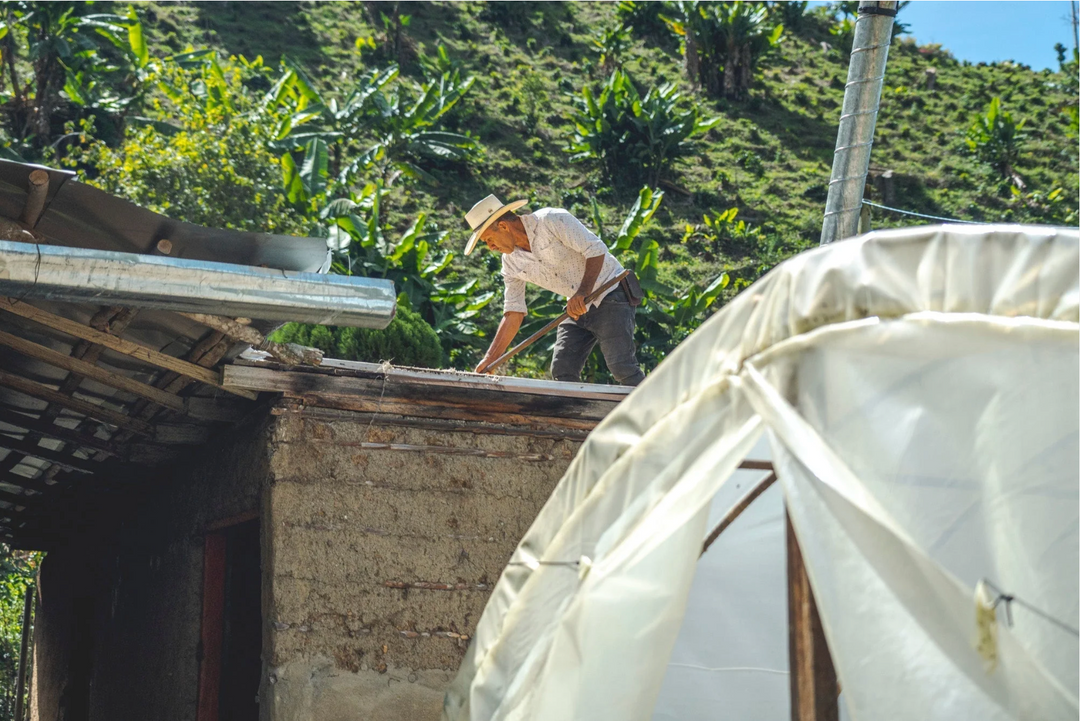
Today, we work with a network of nearly 2,000 partner farmers across the country. The vast majority are smallholders. Their farms are no bigger than five hectares (about 12 acres), and the average is closer to a single hectare. We started by buying coffee from our own farms, and over time we turned that learning into a platform that helps producers much smaller than us stop selling their coffee anonymously. At first, that coffee went mostly to craft roasters abroad. Today, more and more of it also reaches our own shops and our customers in Colombia, always with its origin recognized.
How We Ensure Quality and Traceability
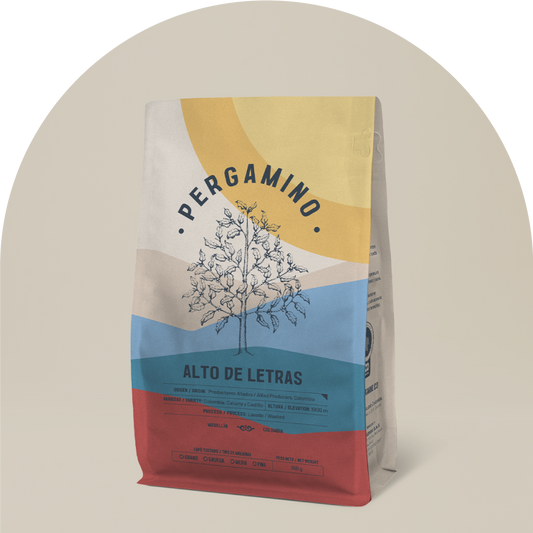
The tool we use to tell one coffee from another is cupping. From the moment a lot arrives at a partner warehouse, it gets a code that keeps it traceable all the way through the process. Every lot goes through a physical analysis (yield factor) and a sensory analysis that assigns a final score. That score decides what happens to the coffee: whether it goes into a blend for a house coffee like Alto de Letras, becomes a seasonal origin or a special edition, or, in the most exceptional cases, joins the 1%.
The difference from the traditional model is easy to picture. Instead of one giant pile, we work with hundreds of small lots, 20, 30, or 50 kilos each, and we cup every one of them. In a single year, we cup around 100,000 samples. That lets us decide precisely which lots stay separate and which get combined, always based on quality and with full traceability. In other words, we might combine several lots to export them as a coffee from a specific region, but we know exactly where each one came from, we can tell that story to our customers, and we can guarantee that every producer received a price equal to what we got for that quality coffee.
Quality, Not Charity: The Mechanism That Makes the Model Work
Let’s be clear about one thing: the partner farmer program is not a philanthropic project. Nothing would make us happier than paying a stable, higher price to Colombia’s roughly 500,000 coffee-growing families, but that wouldn’t be sustainable unless it were backed by something objective. That something is quality.
The mechanism is simple. We can only pay a higher price for coffee we can actually sell at a higher price, whether abroad or in our own shops. The producer who did the work gets that premium, but the starting point is always verifiable, objective quality, never a subjective call. That’s why, even with producers we’ve been friends with for over 20 years, cupping stays 100% objective. We can’t buy a coffee we can’t offer in our shops, no matter how much we appreciate the person who grew it.
The Story of Nilson Pillimué
A great example of how these long-term relationships are built is the Pillimué family, in Inzá. Nilson, who now runs two warehouses in Pedregal and Inzá, was just a shy kid when he met the Pergamino team. Today he’s a family man and a recognized leader in his community. At his San Antonio warehouse, which has a lab, a roaster, and all the equipment it needs, he does the first round of cupping and decides, with support and training from Pergamino, whether a coffee gets bought. His story reflects something that happens in every region where we work: we never operate alone. We work hand in hand with local people and networks who know the community.
Working Hand in Hand With Communities
Every region where we work, including Inzá, Aponte, Urrao, Huila, Tolima, and Nariño, has its own dynamics and its own local partners. But everywhere, we follow the same principle. It’s not about showing up to buy coffee from a single producer. It’s about truly getting to know the community, understanding where the quality is, having recurring access to those coffees, and, above all, building long-term projects.
That support creates a virtuous cycle that, over the years, becomes tangible. We’ve been visiting some of these communities, like Inzá, for more than a decade, and the progress shows: upgrades to homes, bathrooms, and wet mills, access to a motorcycle, and, in the case of one producer who shared a photo of his new ceramic tile floor, dreams finally coming true.
At the beginning, though, that trust wasn’t a given. At one of the project’s first meetings, in Caicedo, a producer openly questioned why she should trust a group of young strangers when she’d expected someone with more experience and gray hair. The answer was simple: the guarantee wasn’t years of experience, but the intention to stay in the business for the long haul, building a lasting relationship instead of taking advantage of one good harvest and disappearing.
Why Don’t We Work in Every Coffee Region?
It’s a common question: why isn’t the program in areas like Quindío, Risaralda, or Valle? The answer has two parts. First, it responds to market demand, which looks for certain coffee profiles. Second, and more important, is the community’s real willingness to work together, learn, and in many cases, change.
Reaching the quality level specialty coffee demands doesn’t happen overnight. The first big decision is usually the variety. Some rust-resistant varieties don’t produce as good a cup, and switching varieties requires a farm at the right altitude. When we reject a coffee, we always share that information with the producer so they can improve, though sometimes factors like altitude make that change very hard. That’s why we focus on areas like Inzá, Pitalito, and Tolima, where we’ve found communities genuinely willing to invest the time, resilience, and flexibility that specialty coffee requires, knowing that every harvest and every climate is different.
How Pricing Works: Two Tiers and Two Premiums
All the coffee we buy is paid above market price, but the model has two tiers. First comes the base threshold: coffees that score 84 points. Then, lots we’re able to set apart above that score become microlots, whether for export, seasonal origins, special editions, or the 1%, and they’re treated differently.
At the end of each harvest, we also make a final settlement payment to the producer: a second premium that depends on how that coffee ended up being sold (what price it was exported at, at what exchange rate, or whether it sold in our shops). So there’s an initial premium and a second one later, and that takes mutual trust. The producer trusts that the second payment will arrive once all the sales data is in.
The final price is always tied, to some degree, to the international coffee market (known as the “C” price), plus a differential for Colombian coffee, plus the quality premium. The exception is the top tier, the 1% and special editions, which are almost entirely decoupled from those swings. Their value stays relatively stable from one year to the next, regardless of what the base market does.
The Impact: Why This Matters for the Future of Coffee
Behind this whole model is a real concern for the future of Colombian coffee farming. The average age of a coffee farmer in the country is nearing 60, and it’s getting harder and harder for younger generations to stay on the land. Without a real economic incentive, one that lets people make a living from coffee and not just scrape by, it will be harder and harder to have great coffee in the future.
Many producers describe traditional coffee farming as an exhausting cycle: harvest, sell, pay the pickers, pay off debts, and the next year take out another loan to start all over again. Choosing to enter specialty coffee is, at its core, a way to break that cycle. When a producer has a more stable income, their family has more reasons to keep growing coffee, and that virtuous cycle is ultimately what lets us keep offering our customers extraordinary coffee.
The Bottom Line
The partner farmer program is, at its core, an attempt to solve a very specific problem: the anonymity with which coffee has traditionally been sold in Colombia. Through traceability, cupping, and a pricing model built on quality, not charity, we’re working to rebuild the connection between the people who grow coffee and the people who enjoy it. It’s work that takes years, built hand in hand with specific communities, and today you can see it in stories like the Pillimué family’s and in the visible progress of regions like Inzá. The next time you drink a cup of Pergamino coffee, remember that behind it is a producer with a name, and a long-term relationship we keep building, harvest after harvest.
Frequently asked questions
What is Pergamino’s partner farmer program?
It’s a network of nearly 2,000 small Colombian coffee farmers, most with farms under five hectares, who sell their coffee to Pergamino with full traceability instead of anonymously, earning a price above market based on the quality of their coffee.
How does Pergamino ensure traceability for its partner farmers’ coffee?
Every lot gets a code the moment it arrives at a partner warehouse, then goes through a physical and sensory analysis (cupping) that determines its score and its final destination: house coffee, seasonal origin, special edition, or the 1%. We cup around 100,000 samples a year.
Is the partner farmer program a charity project?
No. The premium producers receive always depends on verifiable, objective quality, not subjective decisions. The model works because Pergamino only buys coffee it can sell at a higher price, which makes it possible to pay producers more, sustainably, over time.